RESEARCH GUIDE
CJC-1295 & Ipamorelin: Growth Hormone Research
Introduction to the CJC-1295 / Ipamorelin Blend
The combination of CJC-1295 (no DAC) and Ipamorelin represents one of the most widely studied growth hormone secretagogue peptide pairings in current research. These two compounds operate through complementary but distinct mechanisms to stimulate growth hormone (GH) release, making their combination particularly valuable for researchers investigating the nuances of pulsatile GH secretion and its downstream effects.
CJC-1295 (No DAC) — Modified GRF(1-29)
CJC-1295 without Drug Affinity Complex is a modified analog of growth hormone-releasing factor (GRF), specifically a tetra-substituted version of GRF(1-29). It has a molecular weight of approximately 3367.97 Da. The four amino acid substitutions at positions 2, 8, 15, and 27 were engineered to increase resistance to enzymatic degradation by dipeptidyl peptidase-IV (DPP-IV), extending the compound's effective activity window while preserving its specificity for the GHRH receptor. CJC-1295 (no DAC) stimulates GH release through the growth hormone-releasing hormone (GHRH) pathway at the anterior pituitary.
Ipamorelin — Selective GH Secretagogue
Ipamorelin is a pentapeptide growth hormone secretagogue with a molecular weight of 711.85 Da. It activates the ghrelin/GHS receptor (GHS-R1a) to stimulate GH release through a pathway that is mechanistically independent from GHRH signaling. Research has highlighted Ipamorelin's selectivity — studies indicate that at GH-releasing concentrations, it does not significantly alter levels of ACTH, cortisol, prolactin, or other pituitary hormones. This selectivity profile distinguishes it from earlier generation GH secretagogues like GHRP-6 and hexarelin.
Complementary Mechanisms
The rationale for combining CJC-1295 and Ipamorelin stems from their synergistic activation of two distinct pathways converging on GH release. CJC-1295 amplifies the GHRH signal, while Ipamorelin provides concurrent ghrelin-pathway stimulation. Published research suggests that dual-pathway activation may produce GH pulses that more closely mimic physiological secretion patterns than either compound alone. Studies have observed that the combined effect on GH amplitude can exceed the sum of individual compound effects — a characteristic of true pharmacological synergy.
Research on GH Release and IGF-1
Research utilizing this peptide combination has documented effects on both direct GH output and downstream insulin-like growth factor 1 (IGF-1) levels. Studies in animal models have shown sustained elevations in pulsatile GH secretion, with corresponding increases in hepatic IGF-1 production. Tissue composition analysis has examined the relationship between GH/IGF-1 axis activation and changes in tissue composition parameters and bone mineral density markers in experimental contexts.
Pulsatile vs. Sustained GH Release
An important distinction in growth hormone research is the difference between pulsatile and sustained GH elevation. The CJC-1295/Ipamorelin combination is studied specifically because it appears to preserve the natural pulsatile pattern of GH release, rather than producing a constant elevation. Research suggests this pulsatile pattern may be more physiologically relevant, as GH receptor sensitivity has been observed to decrease during sustained exposure — a phenomenon known as receptor desensitization.
Storage and Handling
The CJC-1295/Ipamorelin blend is supplied as a lyophilized powder. Store at -20°C for long-term stability. Reconstitute with bacteriostatic water and store the resulting solution at 2–8°C. Protect from light and avoid repeated freeze-thaw cycles to maintain peptide integrity throughout the research period.
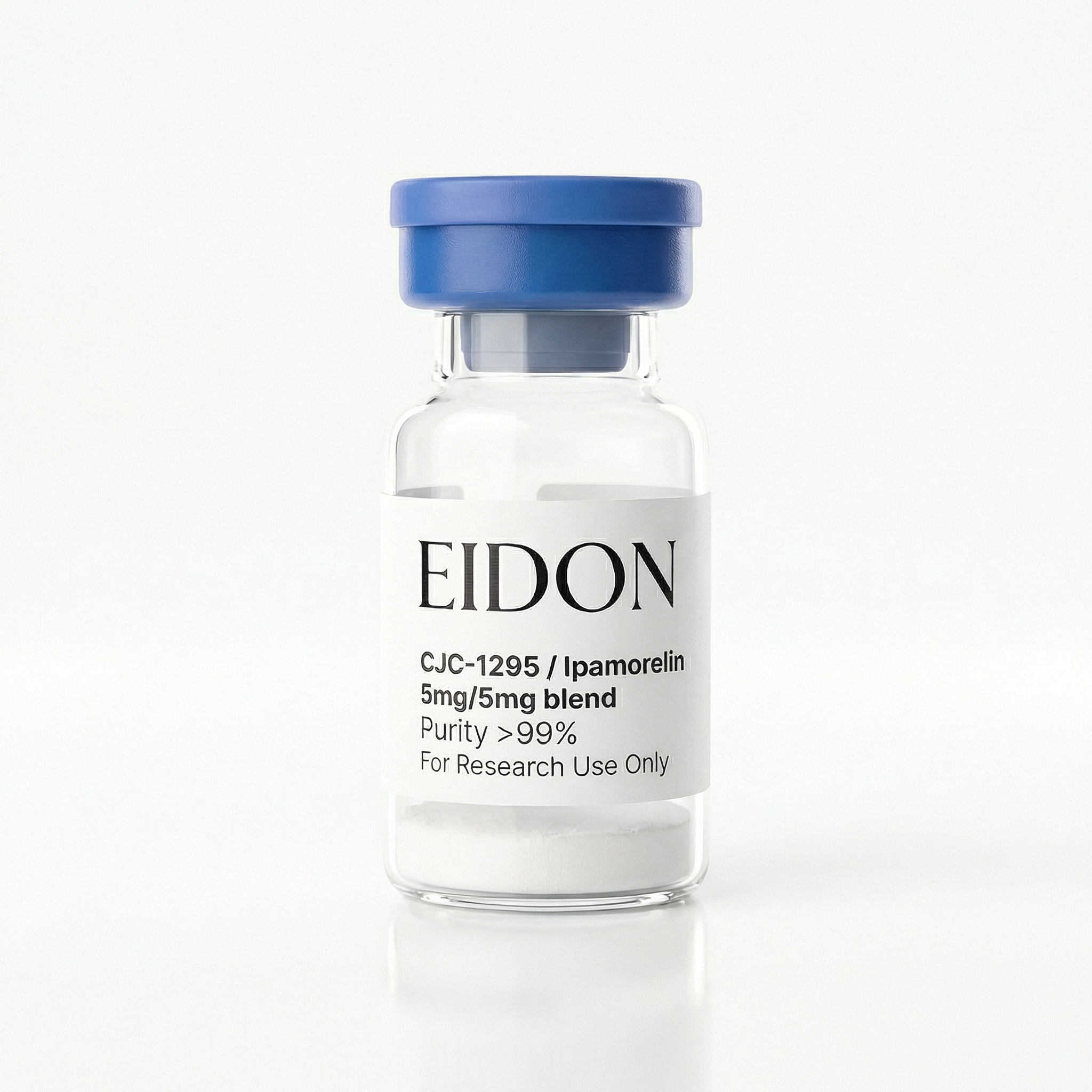
CJC-1295 / Ipamorelin Blend 10mg
Research-grade peptide blend, >99% purity, third-party tested via HPLC at Janoshik Analytical.
View ProductDisclaimer: For research use only. Not for human consumption. This article is provided for educational and informational purposes. It is not intended to diagnose, treat, cure, or prevent any disease. Must be 21+ to order.